
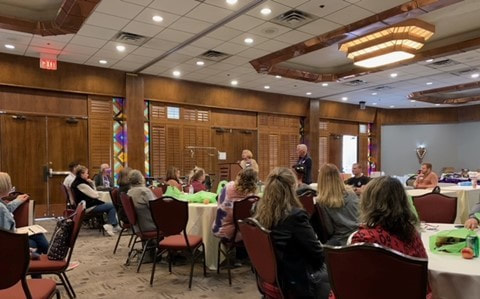
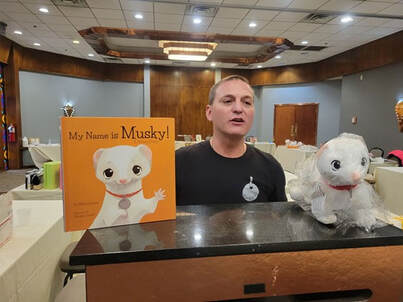
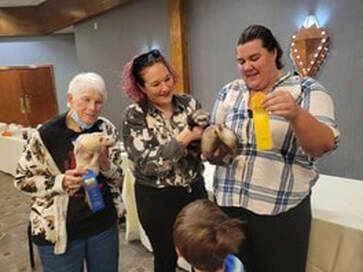
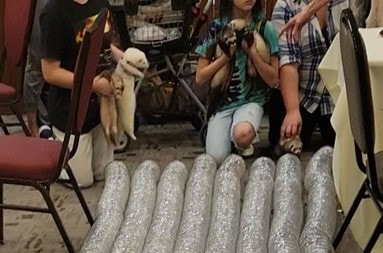
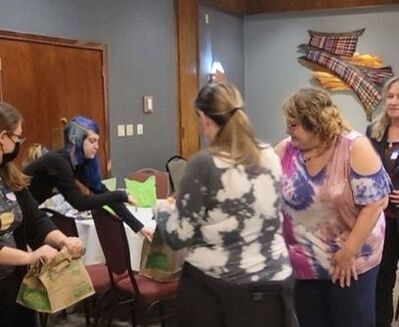
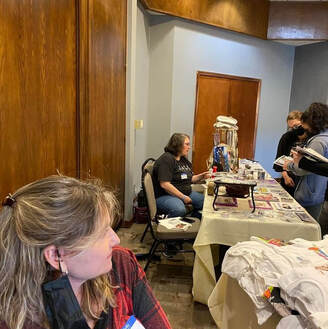
Western States Ferret Round Up - you should have been there! 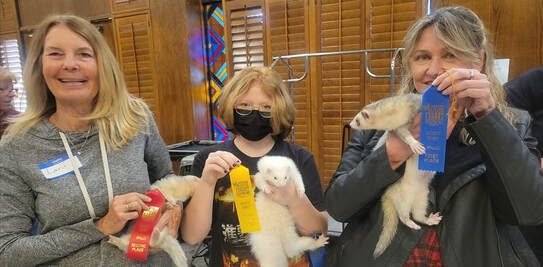 Jan 2022: More than 50 people and half a dozen vendors showed up last weekend, Jan 15 and 16, in Tempe, AZ, to join ferret owners, rescuers, shelters, vendors, and ferret fanciers in person, along with their ferrets. Key organizer of the Ferret Round Up was Patrick Wright, head of LegalizeFerrets.org, a California nonprofit, whose mission is to see domestic ferrets legalized in State of California. Local participants from the Phoenix metro area, especially from the AZ Ferret Rescue, contributed their support and expertise to the event. They were joined by those who traveled from California, Oregon, and as far as New Jersey. Ferrets and the human counterparts participated in the judging of the “biggest” and “smallest” ferret (“Elvis and Twiggy” contest), timed sport of “tip the cup”, ferret tube racing, and paper-bag escape, among others. Program speakers were: Dianne Simonian, director of the AZ Ferret Rescue, Manny Giuliano, retired animal cruelty officer in New Jersey, and the force behind the soon to be published children's book about an abandoned ferret: "My Name Is Musky", and Brittany from the AZ Ferret Rescue, on Ferret Biology. Bonnie Myer, and Melanie Ellis, along with many others, contributed judging and event management skills. Although COVID placed somewhat of damper on the event (boxed meals, no buffet), great new relationships have been built. There are plans now to do this event next year in Arizona. So with lots of help from locals and others, we call this a success!
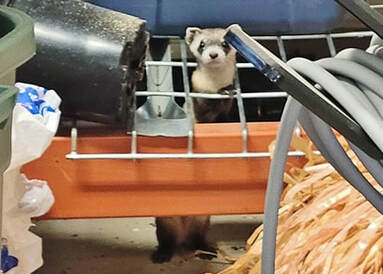
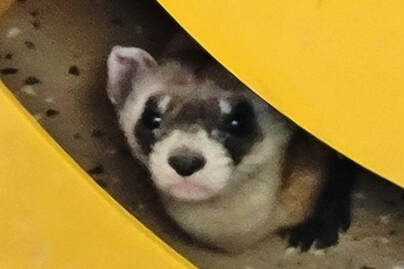
BFF discovered in Colorado homeowner’s garage Pueblo West, Colorado— Nov 10: The rarest mammal in North America made a surprise appearance inside the garage of a southern Colorado homeowner. On Nov 8th an endangered and rare black-footed ferret (BFF) was found inside a garage in Pueblo West, according to the Colorado Parks & Wildlife (CPW).
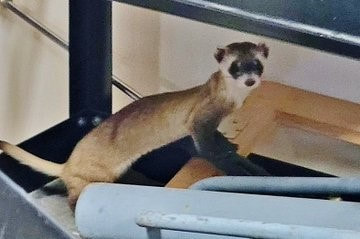 After making the discovery, the homeowners were able to coax the ferret into a box and then contacted the CPW. The garage, located near the Walker Ranch, is where CPW and the US Fish and Wildlife Service have been releasing black-footed ferrets on a prairie dog colony in an effort to restore the endangered mammal in the wild. Since 2013, more than 120 BFFs have been released on the Walker Ranch location.
Each ferret raised for release gets a passive integrated transponder (PIT) microchip inserted between its shoulder blades. Using a scanning device, a BFF can be identified from the information contained in the PIT microchips. An officer from Humane Society of the Pikes Peak Region was able to respond with a portable scanner and confirmed the ferret visitor was one of nine BFFs recently released at a 1,600-acre prairie dog colony at the Walker Ranch nearby. After determining the garage-crashing BFF appeared healthy, Officers Cassidy English and Travis Sauder hiked deep into a Walker Ranch prairie dog colony in the dark and re-released the ferret back into the wild. A video of the ferret's release is at: https://twitter.com/i/status/1458473929857650690 “Any Port in a Storm”-UK Couple Finds Ferret in Bed Fleeing Storm A "large" ferret, nicknamed “Snoozy” for his love of sleeping, snuggled into the bed of a Bristol couple on Friday, Nov 26, as Storm Arwen wreaked havoc on the region. As the storm battered the city outside, a dark sable male ferret was found snuggled up in the bed of a Bristol couple, having snuck into their house. “Quite a large chap for a ferret.” 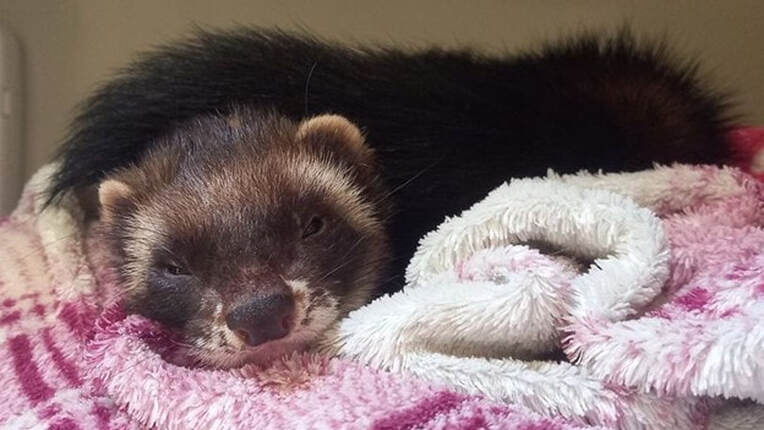 Escaped ferret “Snoozy” slipped out of his owner's home found sleeping in a neighbor’s bed 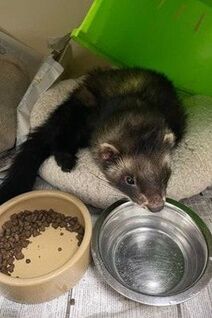 Once discovered, the baffled couple contacted local vets. Highcroft Vets checked him over the following day, christening him “Stinky Pete” after the character in 1995 Pixar cartoon film, Toy Story. After posting photos of the ferret on social media, the veterinary office was swarmed with ferret-related calls.
The ferret was then transferred to the Bristol Animal Rescue Centre (ARC), where he was renamed “Snoozy,” due to his perpetual dozing. “It must have been quite a shock for the couple,” said a spokesperson for Bristol ARC. “Ferrets are really clever and love to escape, and they are terrific diggers, so it’s actually quite hard to keep them contained sometimes. Obviously he’s got out but found himself at night in the big, cold winter storm, so has found a catflap and gone inside to get warm and dry.” “We don’t know the details of the couple who found him, but apparently he got into their bed in the middle of the night. Maybe they have pets of their own and are used to them getting on the bed, but they would not have expected a ferret,” she added. "Snoozy" weighed in at about a kilo [~ 2.2 pounds), "which is pretty big for a ferret. We’ve been calling him Snoozy, because he was obviously pretty tired from his adventure and has spent most of the time with us sleeping,” she said. Appeals to find the real owner of the ferret met with success. “Snoozy” has now been reunited with his owners. From: https://www.mirror.co.uk/news/uk-news/couple-discover-ferret-hiding-bed-25583580 History: 11.4-Million-Year-Old Otter Fossil found 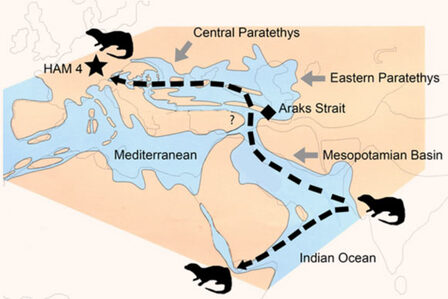 Sep 2021: A new species of the extinct genus Vishnuonyx was recently identified from the 11.4-million-year-old lower jaw bone found at the Upper Miocene site of Hammerschmiede in the Allgäu region of Germany (photo: "HAM 4").
Commonly known as the Neptune Vishnu otters, V. neptuni, due to their origination in the region of the Indian subcontinent, the Vishnuonyx is an extinct genus of mid-sized otters (10-15 kg). These otters are estimated to have lived between 14 to 12.5 million years ago in the major rivers of Southern Asia. The finding represents the first occurrence of the genus in Europe and its most northern and western record. “Recent finds showed that Vishnu otters reached East Africa about 12 million years ago,” said Dr. Nikolaos Kargopoulos, a paleontologist in the Department of Geosciences at the Eberhard Karls University of Tübingen, and his colleagues. Computer-tomographic ("CT") scans were used to visualize the details in teeth of the jaw bone. The teeth suggest that the Neptune Vishu otter dined on "mainly on fish and less on bivalves or plant material, resembling the living giant otter Pteronura brasiliensis.” The discovery of Vishnuonyx neptuni is reported in the Journal of Vertebrate Palaeontology. For more information: Nikolaos Kargopoulos et al. New Early Late Miocene species of Vishnuonyx (Carnivora, Lutrinae) from the hominid locality of Hammerschmiede, Bavaria, Germany. Journal of Vertebrate Palaeontology (online: Sep 16, 2021; doi: 10.1080/02724634.2021.1948858 ) Western States Ferret Round-Up: Jan 15-16, 2022 - Tempe, AZ  allFerrets® is pleased to partner with California's Legalizeferrets.org in hosting the Western States Ferret Round Up!! Join us in sunny Tempe, Arizona Sat Jan 15- Sun Jan 16, 2022 Location: DoubleTree by Hilton Phoenix-Tempe 2100 South Priest Drive, Tempe, AZ 85282 CONTACT ORGANIZERS FOR MORE INFORMATION Bring your ferrets - or just bring yourself!! Doors open at 11 AM, Saturday – January 15th, show ends 1 PM Sunday, January 16th, 2022. Let the fun begin! Round Up Schedule (as of Dec 2021): Saturday, January 15
Sunday, January 16 9 AM: Breakfast with Bob Church - zooarcheologist, specializing in the origins, anatomy, behavior, and ecology of the Ferret and related wild Family members. Ferret Contests:
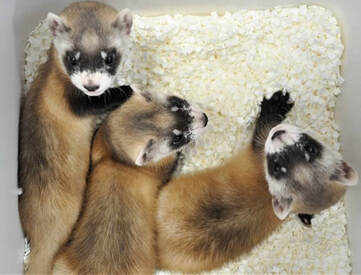
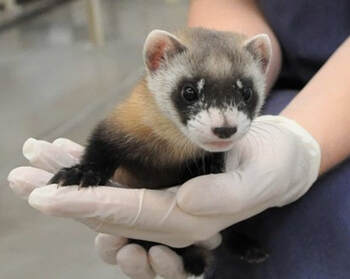
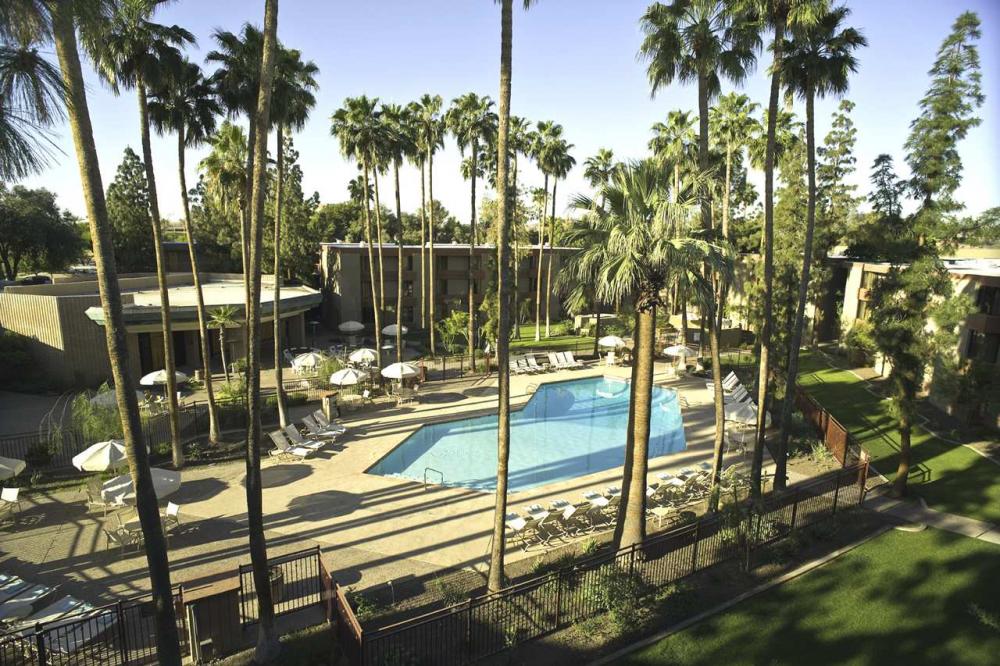 Double-Tree Hotel by Hilton, Tempe, Arizona 3 Female BFF kitS at AZ Zoo: Name Reveal!!! 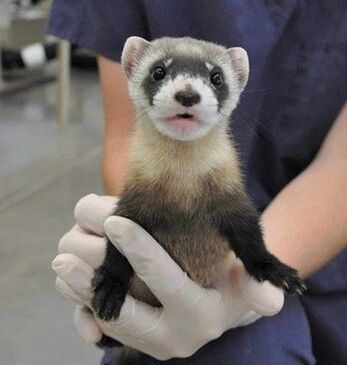 Aug 16: Touted as "the most successful season" for the birth of endangered black footed ferret (BFF) kits, the Arizona Center for Nature Conservation (ACNC) at the Phoenix Zoo, is asking the public to help name the babies. After 2436 votes the BFF kit NAMES REVEALED: See Below!! The ACNC is one of six facilities worldwide breeding BFFs for release to the wild. The BFF is one of North America's most endangered species. Over the past three decades, the zoo has produced more than 500 BFF kits, many that were released into the wild prairie grasslands of Arizona and other parts of their native range. The six mother BFFs are: Mandolin, Lazuli, Ridley, Sedona, Vermillion, and Yoshi, "who are all doing a fantastic job caring for the little ones." In celebration of this milestone, the zoo is asking for help from the public in naming Sedona's--and dad, Jarvis's--litter of three female kits. The kits are about 2 months old. The zoo staff and caretakers suggested the following names:
The WINNING NAMES for 3 BFF kits are the AZ towns receiving 61% of votes!
 Remembering Gail Suzanne Burlaka - allFerrets Founding Member and 1st CEO 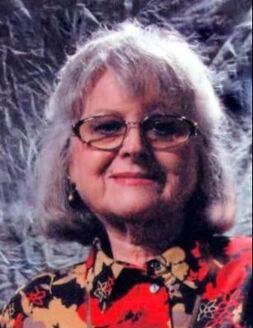 Gail Suzanne Burlaka (1939 - 2021) Gail Suzanne Burlaka (1939 - 2021) allFerrets.org dedicated its first Webinar (Apr 9, 2021 8 PM ET) to Gail Suzanne Burlaka, who passed away on February 9, 2021 at the age of 81 in Bayonet, FL.
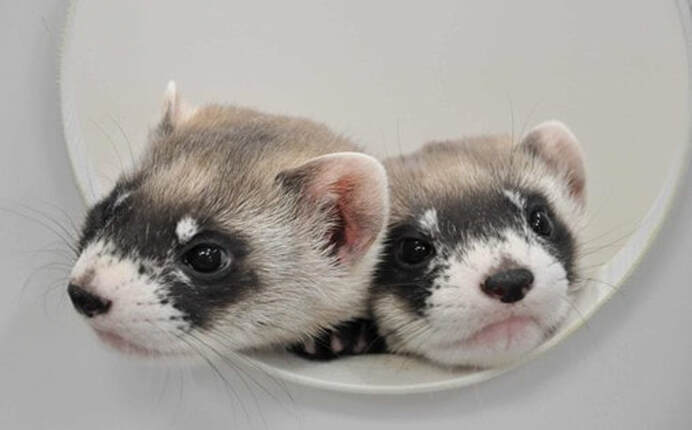
Born on Nov 21, 1939 in NJ, she spent time in Texas and Washington state before returning to NJ where she married and raised a family. A lover of animals, Gail was a long-time member and President of the NJ Burlington County Kennel Club, actively breeding and showing Afghan Hounds for 21 years. In the 1990's, she began breeding ferrets ("Shalamar Ferrets"). She joined the American Ferret Association in 1996, serving on its board of directors, as “Member-At-Large,” until 2004. Shalamar Ferrets participated in 26 ferret championships and in many "Best in Shows," achieving a “Ferret of the Year” award in 2009. Ms. Burlaka was involved in the AFA's efforts to increase federal regulation of underage ferret kits. She also was a strong supporter of the Black-Footed Ferret Recovery Program. In 2010, she was instrumental in organizing a new national ferret organization, the American Ferret Organization, Inc., aka “allFerrets - an Online Ferret Community" where until recently she served as its first CEO. She recognized the need to bring education and connectivity within the "ferret world" encompassing all ferrets. 3/18/2021 Free webinar: 4/09 - 8PM EDS- "The Ferret: A Short History and Legal Status in the United States."Read Now Sponsored by: NeoVac(R)FD - NeoTech LLC   On Friday, April 9, 2021, allFerrets will be hosting a free webinar "The Ferret: A short history and legal status in the United States." Please join us to learn more about the interesting history of ferrets in the United States and their current legal status. AGENDA Ferrets: an American story and history of their legal status Speaker: Dr. F Hoffman, allFerrets® cofounder Legal status of the Ferret in California - yesterday and today Speaker: Patrick Wright, Legalize Ferrets founder 8 PM Eastern DST/ 5 PM Pacific DST  The webinar is free, but registration is required. For more information please see event poster or register at Eventbrite: https://www.eventbrite.com/e/the-ferret-a-short-history-and-legal-status-in-the-united-states-tickets-143450421071 Happy Birthday- Elizabeth Ann!! black-footed ferret clone 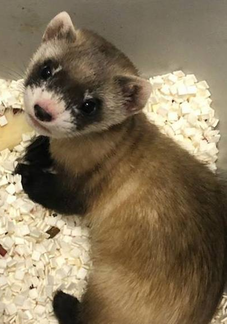 Elizabeth Ann at 48 days (Jan 2021) [US FWS photo] Elizabeth Ann at 48 days (Jan 2021) [US FWS photo] FORT COLLINS, Colorado-The birth of “Elizabeth Ann” on Dec 10, 2020, welcomes the first cloned ferret. She is created from the frozen cells of “Willa,” a black-footed ferret (BFF) who died in 1988, more than 30 years ago. DNA from “Willa” was placed into a domestic ferret embryo in a New York laboratory, and then transferred to a domestic surrogate ferret mother at the National Black-Footed Ferret Center near Fort Collins, Colorado. Elizabeth Ann is the first cloned BFF and first ever cloned endangered species. The black footed ferret (putorius nigra) is the only wild ferret species native to North America. BFF's were considered extinct, until a Wyoming rancher's dog found a BFF in 1981. At the time the US Fish and Wildlife Service (FWS) captured the remaining population - only 18 ferrets. Only 7 of these ferrets passed on their genes in the captive endangered species breeding program. Elizabeth Ann adds genetic diversity, increasing that original gene pool by one. 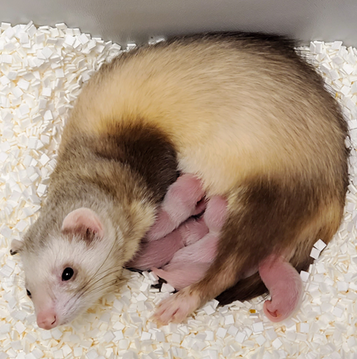 Elizabeth Ann’s surrogate birth mother, a domestic ferret Elizabeth Ann’s surrogate birth mother, a domestic ferret The first mammal cloned was "Dolly" the sheep in 1996. She was cloned from the mammary gland of a 6-year-old Finn Dorset sheep and an egg cell taken from a Scottish Blackface sheep. Elizabeth Ann heralds a new era for endangered species survival. The groundbreaking effort results from the partnership among the US FWS and scientists at Revive & Restore, ViaGen Pets & Equine, San Diego Zoo Global, and the Association of Zoos and Aquariums. The research team is working to produce more BFF clones in the coming months as part of continuing research efforts. Elizabeth Ann will be monitored very closely. Her offspring may not be released into the wild until at least 2026. Selected Reference(s):
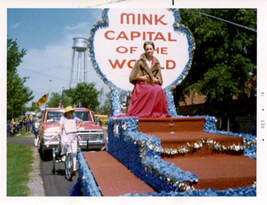
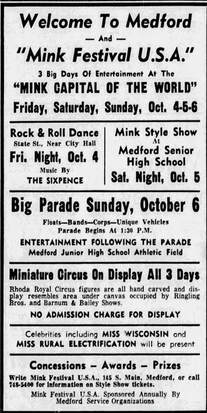
How they Cloned A BFF: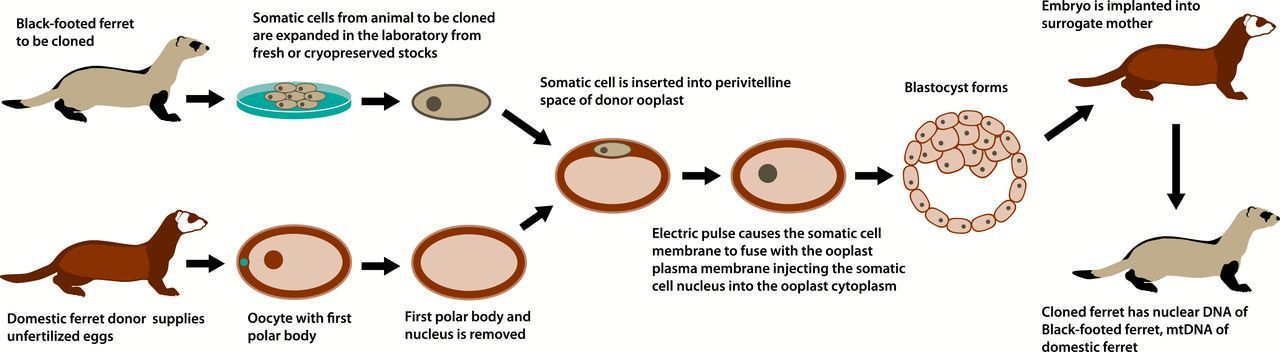 From: Science for Students Covid-19 at Wisconsin mink farming industry 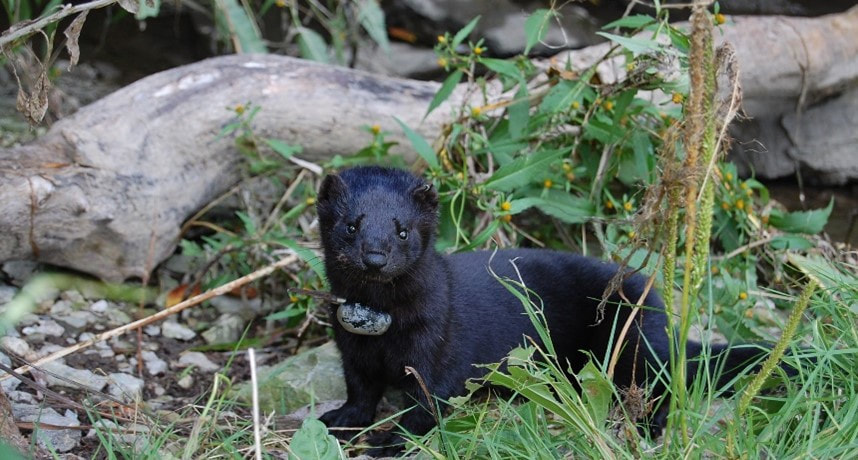 Jan 30, 2021: Last October, not the usual flu virus was seen in the mink at two Wisconsin mink farms located in Taylor County. Mink of all ages and fur coat colors stopped eating, followed by coughing, sneezing, tiredness (lethargy), and then labored breathing. For the next few days hundreds of mink died, in the end, totaling about 5,500 animals. Within a week, after ranchers thought that most of the mink were going to die, the contagion suddenly stopped. Veteran mink expert, Hugh Hildebrandt stated: “... the next morning.....it’s just stopped. They all start eating. They eat more than they ever did before.”
So far there is no evidence in the US, that infected mink can transfer the virus to humans. Even so, there is concern among scientists that mink could harbor a variant of the virus that causes COVID-19 in humans. As a result, the state added mink farm-workers to the category of residents next in line for vaccination against Covid, along with teachers, child-care workers and grocery store employees. In August 2020, Utah was the first state in the US to see farmed mink infected with the virus. This resulted in a nationwide search for infected wildlife. In mid-December a wild mink trapped near a Utah mink farm was confirmed to have the virus. “To our knowledge, this is the first free-ranging, native wild animal confirmed with SARS-CoV-2,” said Thomas DeLiberto and Susan Shriner of the USDA’s Animal and Plant Inspection Service. Soon after that, two more mink — both Oregon farm escapees — also tested positive.
Are mink better at pandemics than humans? Experts state that wild mink “socially distance very well.”
Source: https://www.channel3000.com/wisconsins-no-1-mink-farming-industry-now-seen-as-a-covid-19-risk/ |
Archives
April 2024
Categories
All
|
 RSS Feed

|
Terms and Conditions
|
allFerrets® 2014-2024. ALL RIGHTS RESERVED.
Proudly designed by widgIT |